News and Insights
From Employer Brand to GCC Reputation
September 3, 2026
Why stories that attract talent can also build the external credibility of a GCC.
Global Capability Centers want to be seen as strategic centres of innovation, but many only communicate when they are hiring. Employer branding may be the most underused gateway to GCC reputation. From being a tactical recruitment tool it has the potential to dictate a center’s enterprise influence. An employer brand serves as the perfect intersection of the GCC’s most pressing current need, that is talent and the power of strategic external storytelling. The more specialised the work becomes, the more dependent the GCC becomes on talent. In a hyper-competitive market securing top-tier talent is directly related to the center’s market reputation. This piece traces how employer brand and GCC reputation are not two separate initiatives. They are two points on the same line.
The ongoing attrition and talent scarcity crisis in GCCs is not a human resources responsibility alone. While HR manages L&D, personnel and governance, there are multiple contributing factors to retention and attrition. High-value technical roles are deeply tied to external market perception. Talent acquisition suffers when the target candidates do not understand what a GCC actually builds. They search for inspiration but the regional leadership isn’t visible in industry conversations. As specialized talent increasingly relies on AI-driven discovery to research prospective employers, traditional outreach must evolve to include both Answer Engine Optimization (AEO) and Generative Engine Optimization (GEO). Integrating these strategies ensures that when candidates query a center’s enterprise value, the GCC’s innovation stories and regional leadership surface on the top. CIEL HR’s 2025 GCC Talent Trends and Insights report found that 51% of GCCs considered talent retention their biggest challenge. It also found that 52% of the GCC workforce was open to changing jobs. The numbers suggest that mobility is a permanent feature of the talent market. Retention is less about preventing people from leaving and more about giving them reasons to stay.
HR owns the employee experience. Communication owns how that experience becomes visible and credible externally.
SPAG FINN Partners’ whitepaper defines three defining problems in the GCC Industry – leadership visibility, rising attrition and an AI/ML talent shortage. When a GCC emphasises on operational and communication efforts to build an employer brand, the return is immediate. EY reports that 61 percent of GCC talent prioritizes a genuine culture of innovation and long-term career development over corporate perks. With capabilities and innovation storytelling, GCCs improve candidate consideration and HR efficiencies.
External communication replaces the weak narrative of an “India delivery center” with a “Global capability and enterprise value center”. ANSR’s Employer Branding and EVP Pulse Report 2026 puts the numbers upfront. Organisations with strong employer brands reduce attrition by up to 28%. Only 25–30% of Indian GCCs have made a meaningful investment in PR, communications or employer branding. This missing function handles bridging the perception gap and compensation gap. Most GCCs are investing heavily in the employee value proposition while underinvesting in the external system that communicates it.
Employer branding by definition and function is beginning to merge with GCC reputation. Elevating the employer brand creates a compounding, long-term impact on the reputation of the GCC. As the messaging matures, it expands into broader corporate communications and thought leadership. This includes consistent media relations relaying innovation narratives and active employee advocacy.
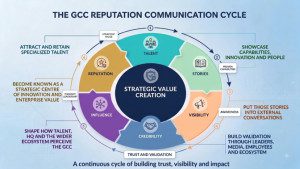
Strategic Takeaways:
Talent is the Gateway to Reputation
Talent remains the primary enabler for GCC growth and transformation. It represents a massive operational focus for site leaders. This immediate step solves for talent attraction leading to long-term corporate reputation building.
Shared Ownership of the Talent Narrative
HR pipelines can’t solve the GCC attrition crisis alone. Strategic external communications bridges external visibility deficit and recognizes a center’s true value.
Reputational Return on Investment
A strong, communication-led talent brand evolves into a comprehensive corporate reputation. It positions the GCC as a global value center capable of winning higher-value enterprise mandates.
For GCCs moving from delivery centres to strategic innovation and enterprise value hubs, employer branding can no longer sit in isolation from corporate reputation.
The next step is to connect your EVP, leadership visibility, innovation storytelling and external communications into one coherent narrative that makes your GCC discoverable, credible and differentiated.
SPAG FINN Partners helps GCCs turn their capabilities and people stories into reputation-building narratives that attract talent, strengthen leadership visibility and reinforce their strategic value.
Explore SPAG FINN Partners’ GCC communications expertise
Frequently Asked Questions
How can GCCs improve their employer brand?
GCCs should start by identifying what genuinely differentiates their employee experience and connecting it to the centre’s broader business value. This can include:
- A differentiated Employee Value Proposition
- Visible and credible GCC leadership
- Employee advocacy and authentic employee stories
- Thought leadership around innovation and expertise
- Media storytelling around business impact
- Consistent messaging across owned, earned and social channels
- Search and AI discoverability through SEO, AEO and GEO
The objective should be to move beyond communicating jobs and instead communicate why the GCC matters.
Why does leadership visibility matter for GCC employer branding?
Leadership visibility gives an employer brand credibility. When GCC leaders participate in industry conversations, share expertise and articulate the centre’s contribution to innovation and business growth, they create a stronger external identity for the GCC. This also helps prospective talent see the centre as a place where meaningful, globally relevant work happens.
How can GCCs become more visible in AI-powered search?
GCCs need to move from simply publishing content to building a consistent, authoritative digital footprint. This means creating useful expert-led content, strengthening leadership profiles, publishing credible data and perspectives, answering industry questions directly, and ensuring that key narratives are structured for search and generative AI discovery.
The goal is not simply to rank for “GCC jobs”. It is to ensure that when stakeholders ask what a GCC does, what it contributes, who leads it, and why it matters, the centre’s expertise and stories are discoverable.
Sources
– Nasscom–Zinnov, “GCC Value Orbit: From Delivery Engine to Enterprise Nerve Centre,” FY2026 India GCC Landscape Report. https://zinnov.com/centers-of-excellence/zinnov-nasscom-india-gcc-landscape-2026-report/
– CIEL HR’s 2025 GCC Talent Trends and Insights report found that 51% of GCCs considered talent retention their biggest challenge
https://www.linkedin.com/pulse/gcc-talent-trends-insights-2025-indias-evolution-story-cielhr-2xwec/
– SPAG FINN Partners, “The Road Ahead for GCCs in India: The Glocal Approach” (whitepaper). https://www.spag.asia/news-insights/the-road-ahead-for-gccs-in-india-the-glocal-approach/
– ANSR, “Employer Branding & EVP Pulse Report 2026 for GCCs.” https://ansr.com/ebooks/employer-branding-evp-pulse-report-2026-gccs
– Nasscom, 2025 GCC India Report (attrition-driver data), as cited in Quantalent’s 2026 GCC talent retention analysis. https://www.quantalent.ai/resources/gcc-india-talent-retention-employer-branding-2026
– EY India, “India’s GCCs are leading the shift to Intelligent, AI-native enterprises,” 25 November 2025 (EY GCC Pulse Survey 2025). https://www.ey.com/en_in/insights/consulting/global-capability-centers/india-s-gccs-are-leading-the-shift-to-intelligent-ai-native-enterprises
TAGS: Global Capability Centers (GCCs), Technology
POSTED BY: